Caravaggio, the 16th-century “bad boy” of the Renaissance, often hired prostitutes to model for his religious works. Not an uncommon practice for the time. What was uncommon about Caravaggio’s work was how raw and real it was. Not your typical Virgin Mary or Madonna. Completely freaking out the art establishment of the day (aka the Roman church).
Jordan Sullivan also paints real people. Despite what are social media feeds and smiles may tell the world, almost everyone is going through some real shit. As someone who knows that world, Jordan currently works with “at-risk” teenagers who suffer from financial struggles, mental health issues, and addiction. He knows that world, and he feels deeply for that world.
Some people don’t like to think of that world, which is understandable. Life would be so much easier if we all wore our rose-colored glasses every day. But life isn’t easy, and rose-colored glasses are dumb. Life is tough for a lot of people, which is why I’ve heard Jordan’s work described as “gritty” and “intense.”
“Don’t make me think about the pain and suffering other people are going through?”

I like people who don’t bullshit me. And I love art that gives it to me straight. I like Jordan Sullivan (he’s one of the nicest, kindest people I’ve met in a long time). And I really like his artwork (someone needs to make artwork for the “underbelly”).
As the first-ever FolkArtwork exhibit, ‘Faces In The Crowd,’ gets closer and closer (less than 3 weeks way until the opening reception!) — I am excited to continue to share the stories of the artists I am fortunate enough to work alongside. This week, I had the privilege of learning more about Jordan Sullivan, why he makes the art he makes and why he feels at home with “the underbelly”.
Introducing, outsider artist Jordan Sullivan:

FolkArtwork: As a high school art teacher, I’m fascinated with students’ art experiences. Especially how confidence affects art making as a teenager in both a positive and negative way. What was your experience as a high school art student like?
Jordan Sullivan: The art program at my high school was very conservative and I didn’t fit into it.
FA: You also have been in the education space and helping young people find their way in this big confusing world we live in, how has that impacted you as a person or your artwork?
JS: I’ve been a social worker counseling kids who are addicted to drugs and alcohol and dealing with mental health disorders. I’ve also worked as an art therapist in rehabs.
These experiences changed my life and continue to. Working with kids, especially under privileged kids who have been abused and neglected, really makes me value life and understand it’s fragility.
Working with people struggling financially and with mental health also reinforces how anti-capitalist I am. At the end of the day it’s the American system that has failed these kids and their families.
FA: Your work is very raw and often straight to the point, have you always had a clear point of view of how you wanted your work interpreted or how did this come to be?
JS: I don’t think there is one interpretation of my work. Hopefully the work is an open-ended question or maybe it might allow someone to see something differently.

FA: Some of your artworks tell stories of what people may see as the “seedy underbelly of society”. Despite that, you pull them off in a calming and beautiful way. What is it about these stories that fascinates you and why are you so interested in telling these stories, sometimes blending multiple realities together in your artwork?
JS: I’ve always been drawn to that underbelly. I’ve lived in that underbelly. Most people in this world are outsiders and that’s really what I’m drawn to – risked lives, lives on the edge.
FA: In this phase of your self-taught art making career, do you remember what those first works were like and how have you seen your art evolve over the past few years?
JS: I think I made some copies of paintings I had seen in the Catholic church where my family and I went every Sunday when I was a kid. I think in some ways I’m still painting devotional art, but I’m not a Catholic and I’m not painting madonnas and saints – I paint drug addicts and sex workers and people just grinding it out – those are the sorts of people I feel devoted to.
FA: Are there any artists, either self-taught or traditional fine artists that inspire you or you look to in your art making practice?
JS: At the moment Roy Ferdinand.
Roy Ferdinand (1959-2004) was a self-taught artist who chronicled life on the backstreets of New Orleans in the years before Hurricane Katrina. Composed on poster board with drug store art materials-ink pens and markers, colored pencils, and children’s water colors. Ferdinand, who died at age 45, often drew on events he saw firsthand, heard about, or read in the pages of the local newspaper. Addressing issues such as gun violence and crime, income inequality, drugs and the war on drugs.
RoyFerdinandart.com
FA: Which contemporary artists currently making art and showcasing art on Instagram are you particularly excited about and why?
JS: I’m not sure about artists, but there are these two bands I really admire right now – Truck Violence and Chat Pile. They really go for it.
FA: As someone who works full time and makes art whenever you can, how and when do you find the time to make artwork? Do you have ideas and jot them down in sketchbooks as soon as they strike or do you set aside some time for yourself and just get to it then and there?
JS: I’m constantly writing stuff down.
FA: When making art, do you listen to music, podcasts or watch movies? Is there any other art form that helps you push through “creative blocks” and gets you in the mood to make art?
JS: For awhile I was listening to podcasts – Death is Just Around the Corner, Chapo Traphouse, Trueanon, and Judge Movies. Movies probably inspire me more than anything else. Cronenberg, lately.
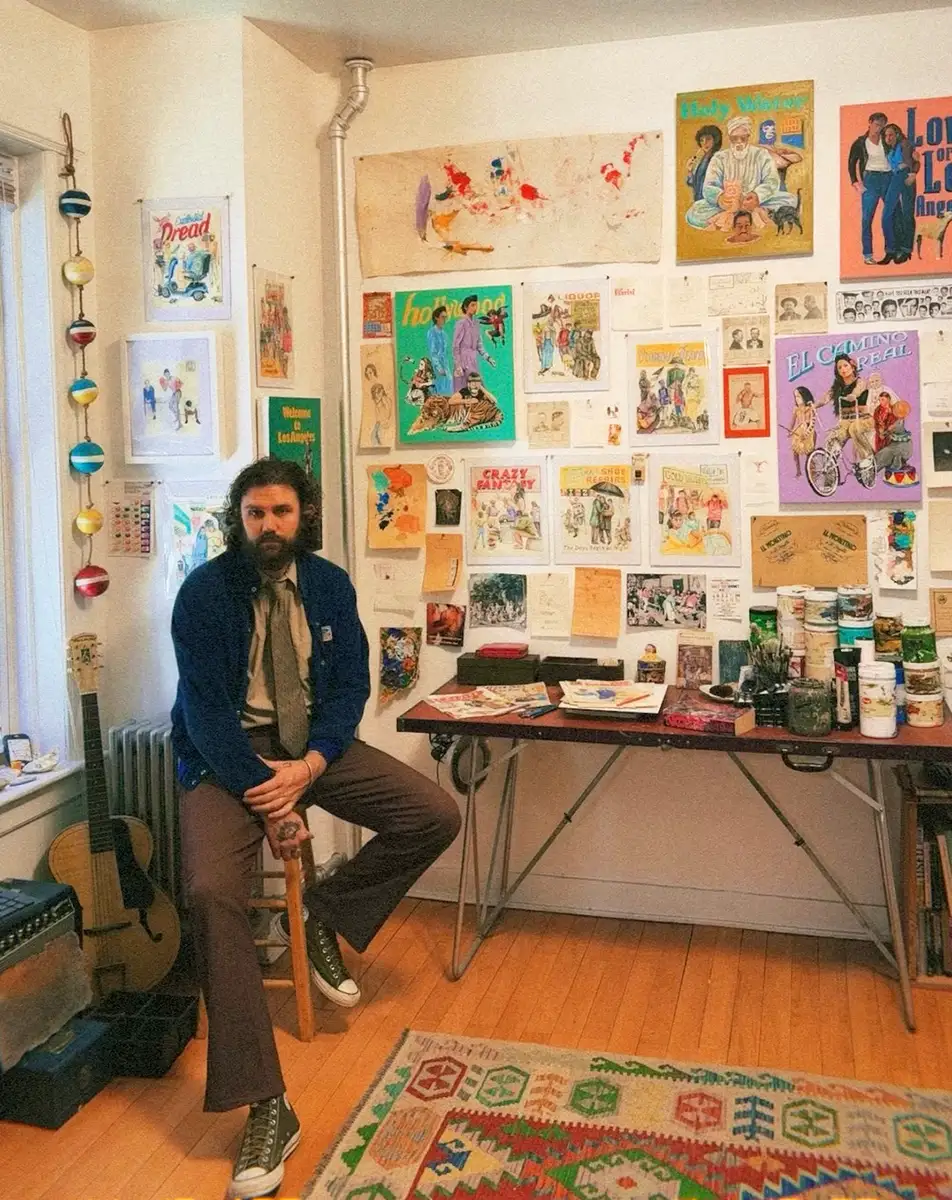
FA: Do you have a specific place you make work in your home? Do you have a studio? And is your art “studio” clean or messy?
JS: I have spare room/closet where I paint.
FA: Do you have any pieces of art you’ve collected that you cherish? If so who is it from and what is it about that art that you enjoy?
JS: A pretzel cross by my good friend Chris Bradley.
FA: Not only are you an incredible painter, but you’re an author and you’ve made some short films as well, are these creative outlets an extension of your paintings or do you see them as something different altogether?
JS: I feel like all of it is part of the same world.
Jordan Sullivan was born in Houston, Texas, and raised in rural Ohio and suburban Detroit. In addition to making art, he has worked as a drug and alcohol counselor at rehabs for adolescents and adults. He lives in Queens, New York.
More of Jordan‘s work can be seen on his website.
You can purchase Joran Sullivan’s work in the FolkArtwork Collective shop. And you can see her work on November 9th at the “Faces In The Crowd” exhibit at the Fitch Building in Des Moines, Iowa.

Leave a Reply