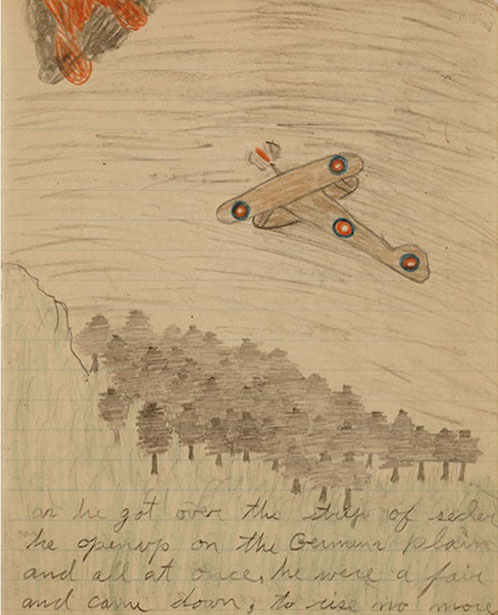
HORRACE PIPPIN Illustrations from War Journals (c. 1917-1920s)
via Smithsonian American Art Museum
Horace Pippin (1888–1946) was an American painter who painted a range of themes, including scenes inspired by his service in World War I, landscapes, portraits, and biblical subjects. Some of his best-known works address the U.S.’s history of slavery and racial segregation.

Per The Met Museum’s “Considering Horace Pippin” by Bryan Martin:
“In 1917, at the age of twenty-nine, Pippin enlisted in the U.S. Army, where he was assigned to the 369th Infantry Regiment, an all-Black group of soldiers. Pippin wrote a vivid account of his service in a sixty-one-page journal containing numerous battlefield illustrations.
These writings provide a detailed account of Pippin’s life-altering injury. When Pippin and his comrade were pinned down in a shell hole by surrounding machine guns and snipers, the two attempted to flank a German soldier. As Pippin moved to another shell hole, a bullet struck him.
More than just a recollection of events, Pippin’s journal strikingly captures a horrific incident that left him with a physical disability for the rest of his life.
In 1919, after the war concluded, Pippin came home with a steel plate connecting his crippled right arm to his shoulder. He was given a disability pension of $22.50 per month, which would be approximately $400 today.”
Every day you can find a brand new piece of folk, self-taught, outsider or visionary art from one of the leading museums, galleries, and collections from across the world. For even more art, follow @folkartwork on Instagram and be sure to subscribe to the “This Week in Outsider Art” newsletter on Substack for two opportunities a week to see even more art, views of my personal collection, finds of the week and a list of must-see shows from across the country.

Leave a Reply