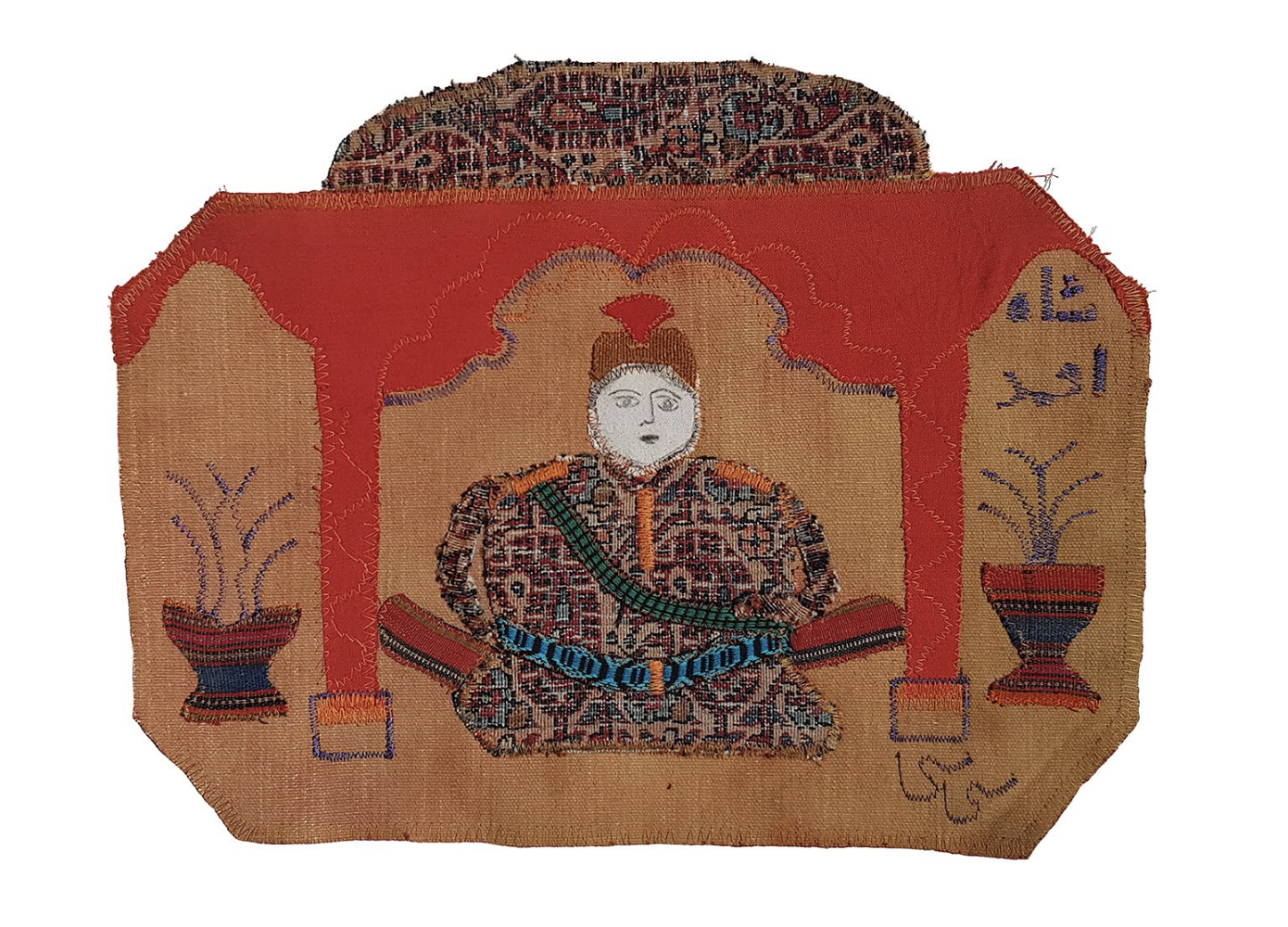
Courtesy and many thanks to Morteza Zahedi and Sarvenaz Farsian of Gallery Outsiderinn
>> Per the Exhibit Catalog <<
Empty Chairs
CC’s works are a product of his intimate familiarity with rustic rug weaving, where weavers would often create and arrange a vast array of patterns and shapes in a spontaneous and impromptu manner. CC’s works reflect a very similar approach, and while he does not use a loom or a predefined design, he makes generous use of textiles and rugs in order to create personal images, collages and patchwork. By applying paint, adding verses and words, he decomposes the original designs and reinvents them as his own. The size and cut of CC’s works have a strong resemblance to traditional rug samplers (called “vagireh” or “aurang”).
His art, while being contemporary in its designs, reminds us of a time where carpets were woven spontaneously, full of faults and errors.
With his playfulness, CC creates a visual language which separates the practical and aesthetic value of his works from traditional clichés. The result is a captivating artistic uniqueness, created free from the knowledge of what will emerge, and how it will be classified.
In “Empty Chairs”, we see this playfulness in full display: he becomes both storyteller and stage designer, the private tailor of both kings and dictators. Like the myths and the fables he has received, from chest to chest, be it in Bazaar alleys or in garment facilities, he invites us into his fascinating depiction, from head to toe, of masculine power.


The Story of CC
Alireza Asbahi Sisi, known as CC (b. 1969, Tehran), grew up as the eldest son of a family of seven. His father, who worked as a tailor, passed away when CC was in 5th grade, leaving him as the breadwinner of the family: CC began working in a garment production facility in downtown Tehran.
His long-time passion for handicraft brought him to the Tehran Bazaar, where he would roam the stalls during the week, buy rustic-weave carpets and kilims, and sell them in the city’s Friday Market. When the market closed down in 2019, CC began working as a taxi driver.
Meanwhile, in order to cover his family’s living expenses, he bought an industrial carpet sewing and embroidery machine. His idea was to roam rug cleaning facilities, collect bits and pieces torn beyond repair during the washing process, and sew them together to create patchwork rugs. He was soon to find out that his sewing machine was not fit for this purpose, and that he didn’t have the means to buy the machine he needed. And thus, one day, as he was sitting in his workshop, he suddenly and spontaneously created his first collage: a rug featuring the lion and sun motif.
Given his environment at the time, CC not only failed to receive encouragement for his art; he was often reprimanded and told that he was wasting his time. He thus ventured into the antique market, which also proved to be unsustainable due to the economic situation of the country. In the fall of 2019, CC made the acquaintance of Morteza Zahedi of Outsider Inn Gallery, who saw the potential in his creations. Having received the necessary support and encouragement, CC is now making his living from his creations, in addition to being a taxi driver

Leave a Reply