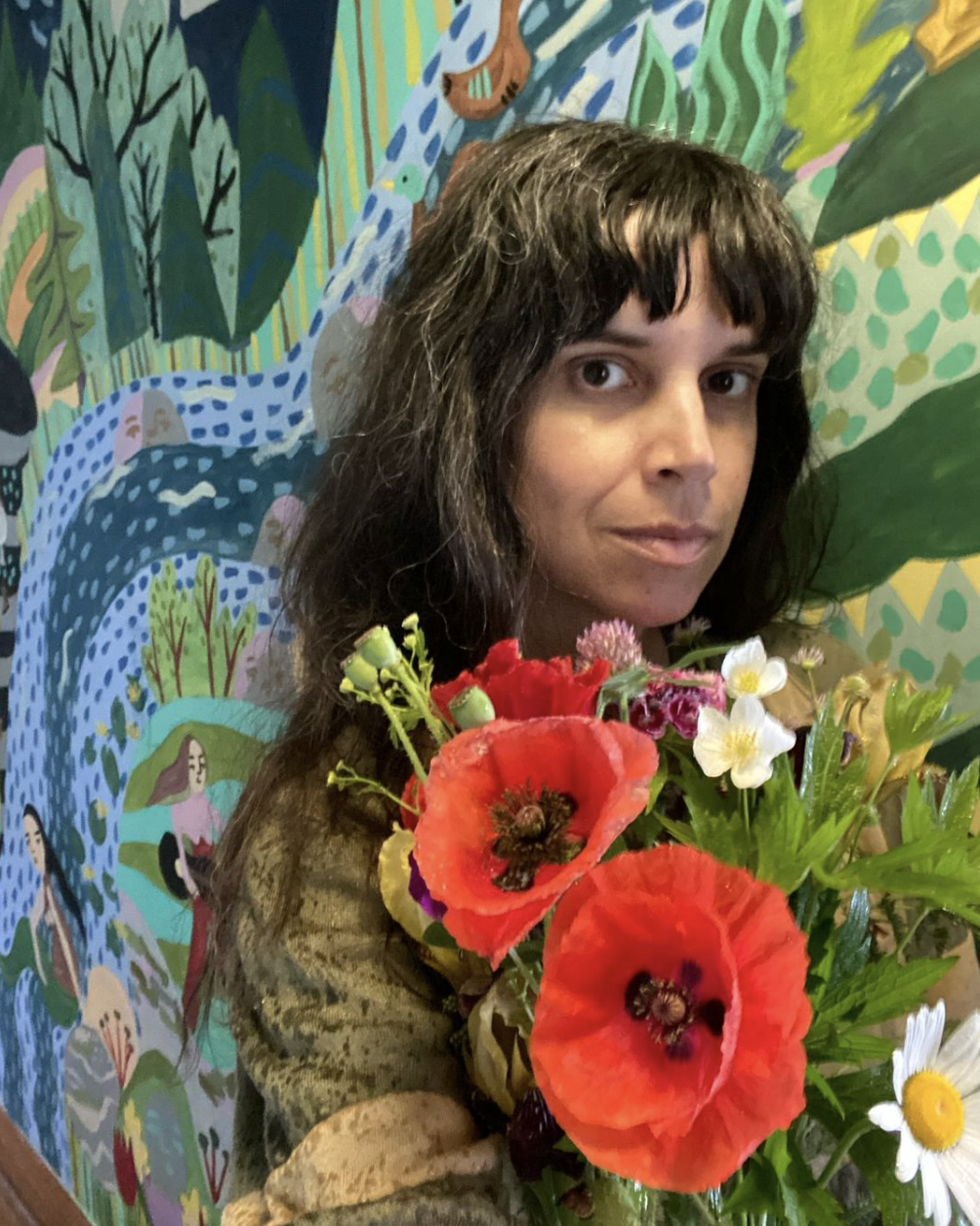
To see Jackie Bradshaw’s work on your phone or computer is one thing, but there’s nothing like seeing them in person. I’m fortunate enough to own a few works of Jackie’s, my wife has a few in her office, and I now have the privilege to sort through stacks of her works for a few upcoming shows.
To see all the details, following the movement of her artworks with your eyes to discover new things. A fish in the river, the bird on the back of a cow, a planet with eyes. Her works continue to surprise me, and always bring a smile to my face.
Not only are her works great, Jackie is one of the nicest and friendliest people I’ve known. I am honored to be able to be a part of her art journey, and I’m lucky enough to call her a friend.

As the first-ever FolkArtwork exhibit, ‘Faces In The Crowd,’ gets closer and closer (less than 2 weeks away until the opening reception!) — I am excited to continue to share the stories of the artists I am fortunate enough to work alongside. This week, I had the privilege of learning more about Jackie Bradshaw’s start to art making, her visit to Maud Lewis’ house, and keeping her demons at bay.
Introducing, Canadian folk artist Jackie Bradshaw:

FolkArtwork: Can you tell me a little bit about your background? Have you lived in Canada your whole life? What’s some of your favorite things about living in Canada?
Jackie Bradshaw: I was born in Guelph General Hospital and grew up in a little village called Eden Mills. It is well known for its writer’s festival. We used to get authors from all over to read passages from their manuscripts.
My sisters and friends would try to make money from the folks traveling to hear the authors read. We would set up lemonade stands, sell baked goods, make beaded necklaces, and face paint for the kids.
I spent a lot of time wandering around the forests in the area, searching for treasures and creatures and collecting cool rocks, sticks, pine cones, and snail shells, among other things. I always loved to pick wildflowers and bring them home to my mom. I was lucky to have such a lovely childhood.
I lived there until I was 17, then moved to the nearest city, Guelph, and spent one year in Montreal. Then, I moved back to Southern Ontario to attend nursing school in Kitchener, where I ended up staying. I have always lived in Canada.
FA: As you know, I teach high school art. One thing I see kids struggle with is confidence in their art making ability. I’m fascinated with teenagers’ art experiences in both a positive and negative way. What was your experience making art throughout your days as either an elementary, middle or high school student?
JB: My memory could be better regarding school, as I struggled pretty mightily. I found it extremely draining. It would just wipe me out. I now know I have a sensory processing disorder, so it was always hard to focus with the noise and bright lights. I used to get lots of headaches and stomach aches and was afraid to use the bathroom, and would often hold it all day.
I remember that art was always one of my favourite parts of the school. And once I discovered that doodling on things helped distract me from the commotion I would always cover all my papers and binders with intricate ink drawings. I remember in high school when I took art, I was obsessed at the time with microscopes so my entire project was based around amoebas and paramecium. I made a water drop sculpture using wire, paper mache, and paint. I was proud of it.

FA: You’ve mentioned that it wasn’t really until you started a home daycare, and it wasn’t until the kids paint that was left out when you started painting. What was it about that experience that clicked for you? Was art making after that something you instantly knew you wanted to pursue?
JB: I should clarify that it wasn’t until after this time with the kids that painting became my hyper fixation. I dabbled in painting a little bit as a kid and teenager, but I never really got hooked until this time when I had daycare.
I go through phases of things that really interest and obsess me. Right now, it is painting, but before that, it was many other things. Like dinosaurs, trains, gerbils, birds, songwriting, healthcare, rocks, etc.
I have been obsessed with painting for almost ten years, but this could switch to something else. I don’t know when it could happen.
I am generally okay as long as I have something to focus on. It is the in-between times I fear. That no man’s land between my current interest and it fading until I find my next obsession. I hope to keep painting though. I hope to stay in that place with it so that it feels like a calming way to express myself and keep the demons at bay.
FA: From your early work until now, can you see an evolution of progression in your artwork? What were some of the original thoughts and feelings about your work when you first started and what are some thoughts and feelings you have about your work today?
JB: My early work with painting, when I really got obsessed, was strictly mirror images. I would use paint blobs, fold the paper in half, and pull out an image I could find.
I realized this is a game I always played, even before the paint. For instance, I would search for images with the wood knots of the panels in my childhood room, in clouds, or in rockfaces. I was always seeing creatures and faces, and sometimes, it was quite scary!
But then I realized I could do this with paint. So I took something often uncomfortably obsessive and turned it into a positive with the paint. Now, I don’t do too many mirror images, but I still use this technique of finding hidden messages in a blob of paint.

FA: While somewhat new to me, Canada has such a rich tradition of folk artists. You recently visited the home of Maud Lewis even painted a “paints for sale” sign similar to hers. What was that experience like for you and has it affected your artwork in any way?
JB: Visiting Maud Lewis’s home in the gallery, being in Nova Scotia, and seeing some of the sites she would have seen was an amazing experience for me. It was very emotional, and my family had to drag me away from her painted home. I wanted to stay with her brushstrokes forever. I could feel her presence in that house, and I could picture us having some tea and talking about our homes and our paintings. I think we would have been really good friends. Maybe everyone feels this way of someone of a somewhat celebrity status that they admire. Maybe this makes me delusional, but I don’t care we have a lot in common!
After seeing Maud’s home I just want to keep adding to the paintings in my home. Not necessarily in sweeping murals like I have been doing, but random playful brushstrokes and little pictures here and there that don’t necessarily have to connect. Which is actually hard for me.
I have been wanting to paint a fish ladder going up my basement stairs for a while that flows into a waterfall lady. And I want to paint my kitchen cupboards. And furniture I have mostly found on the side of the road or in thrift stores. My problem is, though, I run out of steam. Either way, I do have big (small house) domestic dreams of things I want to paint.
FA: Other than Maud Lewis, are there any artists, either self-taught or traditional fine artists that inspire you or you look to in your artmaking practice?
JB: I really love Henry Darger. He is probably my favourite artist. I love that he was a custodian who made these incredible pictures and stories that no one knew about. I love that he created his own world to escape his own hardships. And really, I love that he was a custodian!

My grandparents were both custodians when they came to Canada from St Vincent. They made a beautiful life for their family doing that hard work. My grandma always said, “dirty work, clean money”.
Now, I am married to a custodian, and no one knows it but me, but he is the most brilliant and humble person I have ever met. He writes these incredible story songs in his head while he works. He knows so much about everything! He is so sensitive but also strong. He is kind. And he doesn’t care what people think of him. I imagine Henry Darger was a lot like this.
Henry Joseph Darger Jr.(April 12, 1892 – April 13, 1973) was an American writer, novelist and artist who worked as a hospital custodian in Chicago, Illinois. He has become famous for his posthumously recovered 15,145-page manuscript for a fantasy novel titled “The Story of the Vivian Girls”, along with several hundred drawings and watercolor illustrations for the story.
WIKIPEDIA
FA: I know you’ve painted your home, the stairs, walls and much more. Do you have a specific studio that you like to paint in? Or is it just wherever you are feeling inspired to do so? Also, is your “studio” space clean or messy?
JB: My workspace used to be on the dinner table, but it got difficult to always clean up and move my stuff when it was mealtime. So, two years ago, for my fortieth birthday, my family bought me an art desk, which I put in the corner of our living room near the window, so now I work from there.
I am the type of person who cannot work in disorder, so it is pretty clean at all times. It is definitely paint splattered, as is the floor all around it, but it is orderly and clean, and the entire house has to be this way before I can really focus on painting. I would get a lot more artwork done if this weren’t the case, but that is okay.
FA: When making art, do you listen to music, podcasts or watch movies? Is there any other art form that helps you push through “creative blocks” and gets you in the mood to make art?
JB: When I paint, I sometimes listen to music, but mostly, I sing the same couple of lines of whatever I have in my head repeatedly. Before I start commissions that I do for folks about their love stories, I take my canvas out, place it in front of me, pick up my guitar, and write a little song about the information they have sent me. This is what they hope to see in their painting. Usually, in doing this, the whole story unfolds as it should on the canvas, and usually, things appear that they didn’t tell me about. It will be a cool surprise for us both.

FA: You work in both watercolor and acrylic paints. Do you have favorite material or medium to paint, and how has experimenting with materials helped you as an artist grow?
JB: I love watercolours the most, I think. But I also love painting my walls, so I love acrylic. I enjoy switching between various mediums. I also like ink, crayons, pencil crayons, and sometimes even oil paint. Art supplies are expensive, though, and I often can’t afford the good stuff from the art stores. So I use what people have gifted me or just things from the dollar store.
Right now, I have some leftover paints from a community mural I did in my neighborhood, and I am grateful for that. This is the good stuff! I am used to the thinner consistency of the dollar store paint, but then I feel guilty that maybe the paint I use is not great for the environment. In fact, painting is probably my greatest guilty pleasure, as I am pretty considerate of the environment in every other aspect of my life.
Ideally, I would use all homemade paints or learn to make my own. This may become my next special interest. But yes! Various mediums help bring out different things in pictures. Each pencil or paper or blob of paint comes from a special source, and they all have a story to tell if you are willing to listen.
FA: What is one goal you have with your artwork that you would like to do or see it be?
JB: I am in the process of applying for an art installation with another artist at my local community centre. I would love to get this opportunity to share more of my work with my community. I also really hope I can send more art to be hung in individuals’ homes. I am a homebody, so thinking that someone has one of my paintings in their own space that maybe brings them joy or brightens their day makes me really happy.
I am grateful to everyone who supported my art-making.
FA: Is there anything else we should know about you or you want to share?
JB: I am grateful I get to be an artist right now. And also a mom. I live with endometriosis, and I like to advocate for others who deal with this awful disease. There will be many days you want to give up, but I hope you keep fighting and find ways to experience peace in your lives.
Please don’t give up. I will try not to as well. Gosh, we are made of tough stuff!
More of Jackie‘s work can be seen on her website.
You can purchase Jackie Bradshaw’s work in the FolkArtwork Collective shop. And you can see her work on November 9th at the “Faces In The Crowd” exhibit at the Fitch Building in Des Moines, Iowa.

Leave a Reply